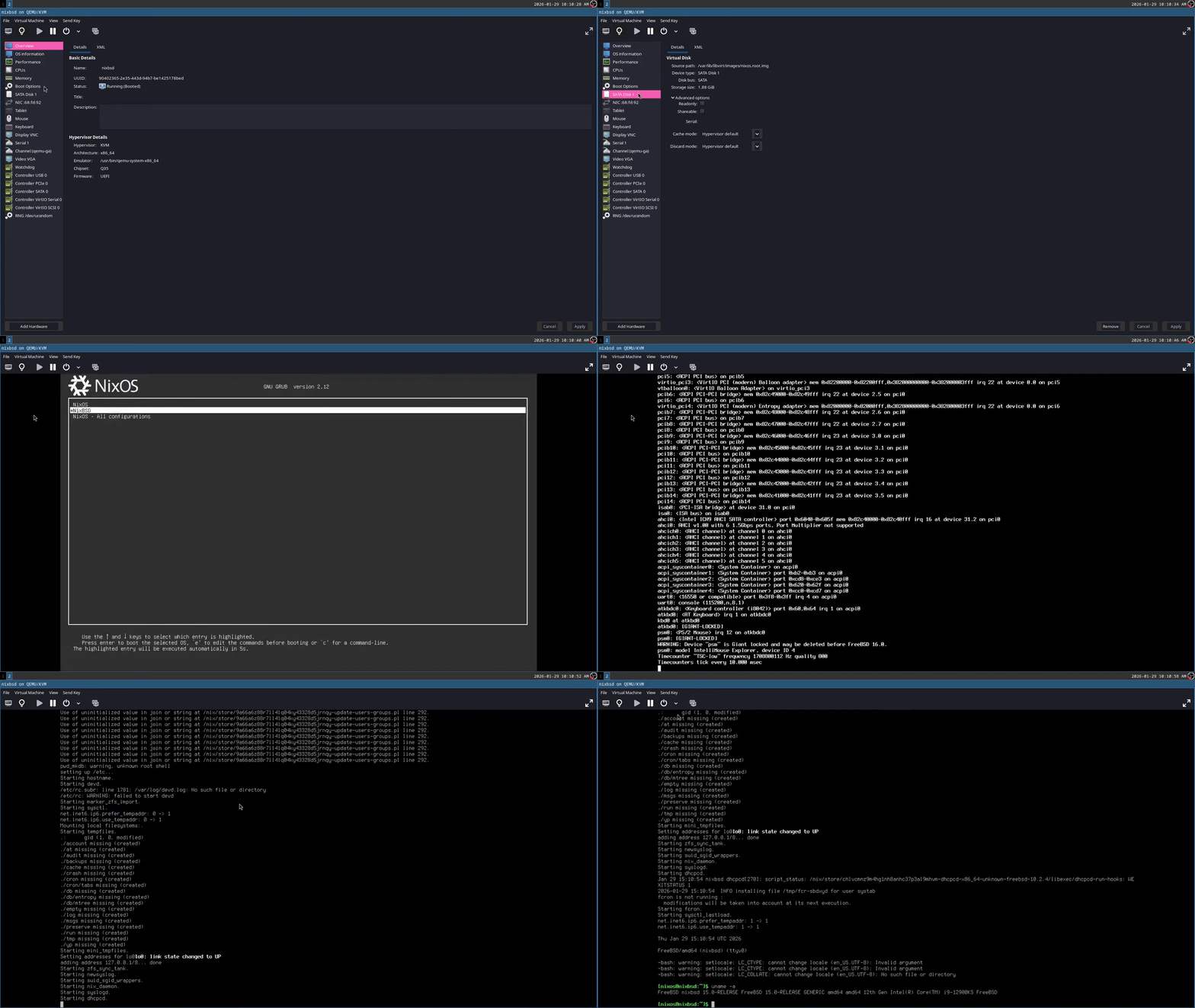
The hardest parts were getting mounts working at boot, making the bootloader setup idempotent, and debugging early init. This disk image could potentially work on a USB stick with a bit more work.
This is very much experimental. My goal is to eventually produce a proper NixBSD installation ISO and consolidate all configuration into one repository while still consuming upstream NixBSD as a flake.
as I said on HN, and also in the Asterinas NixOS (Linux alternative with Nix userland) thread, I think no more Linux monopoly is the future — we’ll be playing different kernels against each other, restoring OS competition and speeding back up the pace of OS innovation.
The word “NixBSD” causes a lot of excitement, but I feel like it’s a little weakly defined here.
Do you run a NixOS-like userland with simply the kernel switched to a BSD kernel?
Edit: I read your HN comment that NixBSD is actually a well-defined project with more activity and maturity than when I last checked it. I apologise for the lack of research before asking this question!
Because from what I associate with a BSD is:
Unified development: The kernel and userland are developed together, tested together, released together. This is philosophically similar to NixOS’s approach of treating the entire system as a coherent, reproducible unit.
Ports/packages as secondary: In FreeBSD/OpenBSD, the base system is the “real” OS; ports are add-ons. NixOS is a byproduct of nixpkgs and doesn’t exist independently of it, so would a NixBSD be more like NixOS, or more like FreeBSD in this regard?
Configuration simplicity: /etc/rc.conf as the single source of truth for system configuration echoes NixOS’s configuration.nix, though declaratively rather than imperatively. I think this is where NixOS and BSD align the most, but also where I’d expect a remake of NixOS’es options to seek the simplicity of BSDs.
Regardless of your interpretation, I’m very happy to see someone work with these concepts!