I’m not opposed or pro your message but I did want to inform you of something
I use “woke” in quotes because I refuse to give legitimacy to a term explicitly made up by alt-right and far-right groups to villainize human respect for all people.
Woke was actually created by black Americans to bring awareness of police brutality and racism still going on post civil war. It was coined just after the great depression. Don’t give racists credit they don’t deserve.
The fact that the first reply to this ignores the point of the article to focus on the factuality of a single claim made in a footnote which does not actually have any bearing on the point of the article, and is fairly high on the “likely to spark angry arguments” scale, is… depressingly fitting.
I’d argue it’s a microcosm of allowing the trolls to control the narrative 
And it shouldn’t spark any arguments, as it’s a well-known and documented fact that the word predates this decade.
Edit: to be more specific, were the author to take their own advice, the footnote wouldn’t exist.
Hi, I’m the author of the article. I was ignorant of the true origin to “woke” and I’d like to sincerely apologize for it. I asked several friends to proofread it beforehand and nobody caught the mistake, so I made sure to add an erratum so people can educate themselves better.
Also, to set the record straight, I did not intentionally unlist the article due to backlash or trying to avoid criticism or whatever people have said. Rather it’s because the way I deploy my website is rather cursed and involved multiple Git repos in a chain, and somehow one stale repo kept overriding my main repo from which I automatically deploy the site. That should be fixed now.
Thank you all so much for spending your valuable time on my writing — hopefully next time I’d write about something more positive than this
(post deleted by author)
The fact you noted this at all just to attack me is just as depressing. People are allowed to not hold opinions on things. I just wanted to educate OP and possibly anyone else in the comments.
Ironically you claim to not wanting to start a flame war without realizing your comment does directly that.
No apology necessary, it wasn’t a mistake you just didn’t know something, it’s all good.
This post reminds me of the maxim from Michelle Obama of “when they go low, we go high”. I understand the instinct behind that, but I’ve come to believe it’s not actually a very effective communication strategy, at least not on the individual level.
Personally, I’ve been doing something very different. I’ve been engaging more with the argument where people are making them, whether that’s twitter, reddit, linkedin, or even people that have DM’ed me to follow up on points or questions. Just in a low stakes, informal way, where I’ve not been too concerned if I was constantly a perfect arbiter of of respectability. In other words, just a human talking to humans.
My experience has been overwhelmingly positive. I’ve had so many people tell me they came away with a totally different impression of NixOS and the validity of it’s decisions on many contentious issues, and changed their mind about many of the most often repeated and loudest criticisms, most of which I find are some very misplaced social criticisms. Many of them were just hapy that there was a “normal sane” person there willing to talk to them, without a flat, institutional, or careful “respectible” style of communications.
I think there is a danger in setting the bar for discourse so high that we effectively decide some people, arguments, or venues are beneath engagement. That can feel principle, but in practice, it often just means that the only people willing to engage with someone’s fear or frustration are the people presenting the most negative and exaggerated version of events, and not the ones with the most information about them. Also risks making the bar for those people so high that all their communications must be overly formalized, making the bar to entry for those with high context on issues higher than they’ll find worth engaging, which isn’t actually good for anyone.
Often, what actually helps is a lot simpler: having a sane voice in a conversation that’s not to proud to engage with peoples worries, acknowledge the parts they’re concerned about and address them directly, and provide counterweights to the scapegoating and catastrophizing coming from some people, many of which have good reasons to misrepresent or overblow the events, either to increase engagement with their product launches, or to stir up attention for their own efforts, or to validate their own choices and to not have to take the project seriously.
That doesn’t mean accepting abusive behavior, endlessly arguing with trolls, or abandoining any sort of standards. And it also doesn’t mean never conceding faults or having to “hold a line” or “win the argument”, that’s not even really important. But being there and acknowledging mistakes, and making them and owning them, that helps, and humanizes, adn shows that we’re not two sides of some fight.
Tone, informality, humour, and even engaging with arguments we think are badly framed can be useful tools if the goal is actually to change minds rather than merely demonstrate that our own standards of discourse are better.
There’s a political analogue here in the criticism of the “they go low, we go high” approach. Maintaining the moral/rhetorical high ground is not necessarily the same thing as persuading people. The more recent idea sometimes described as “Dark Woke” is, in part, a reaction to that failure mode. I think that regardless of any politics surrounding such discussions, it’s prudent to learn from examples of modes of communications that have repeatedly failed to achieve the outcomes they profess to be intended to bring about.
I am a staunch, card carrying consequentialist, and largely judge things by their outcomes. It’s probably no suprise that I’d rather judge communications by whether or not it gives a more realsitic of understanding of what’s actually happening, instead of leaving the field to a handful of negative first accounts from people with bad moderation outcomes. And I think part of doing that is showing that not every interaction has to be high stakes. We can overlook some mistakes in tone, engage with people who start out with wrong ideas, and give them room to learn rather than treating every imperfect interaction as disqualifying. Doesn’t mean we have to tolerate abuse, certainly doesn’t mean we will change everyone mind either. But I find that this is a much more productive mode of conversation.
I also don’t believe in the futility of communicating on these issues, specially ones surrounding Omarchy.
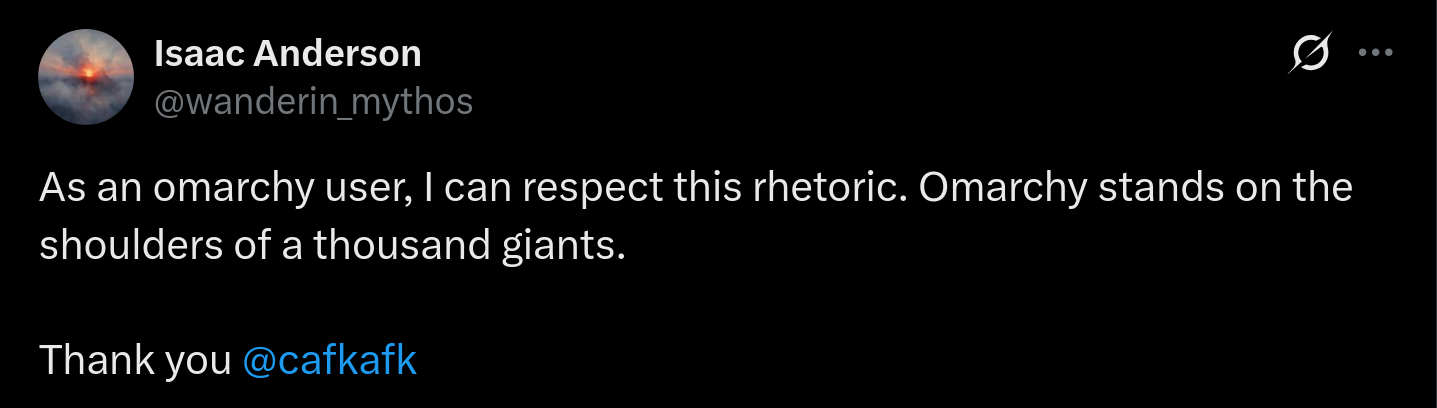
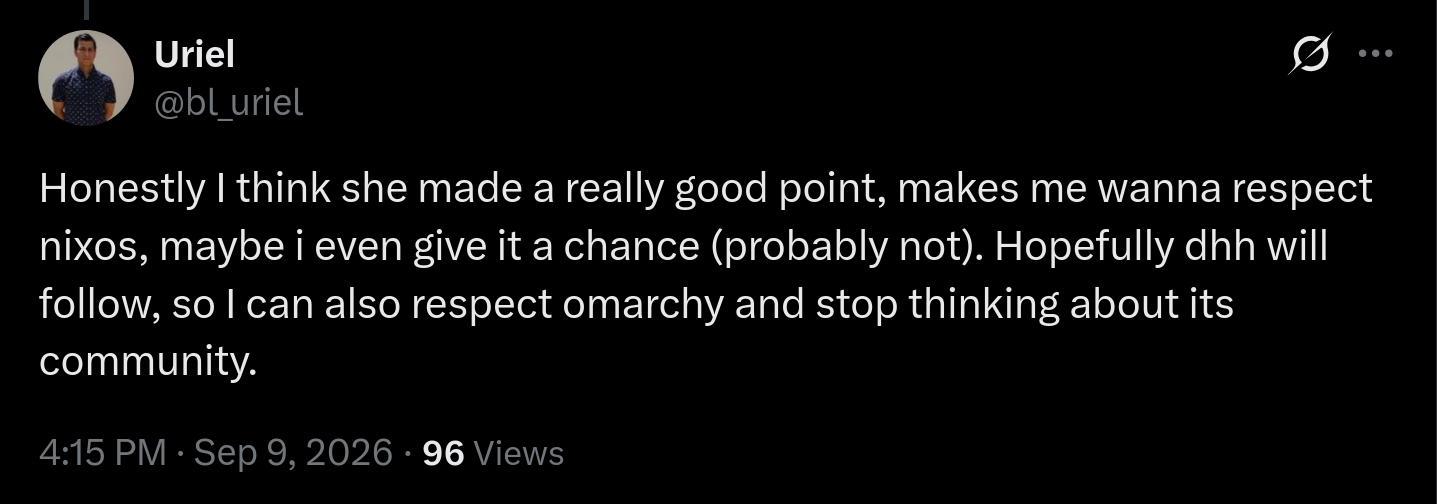
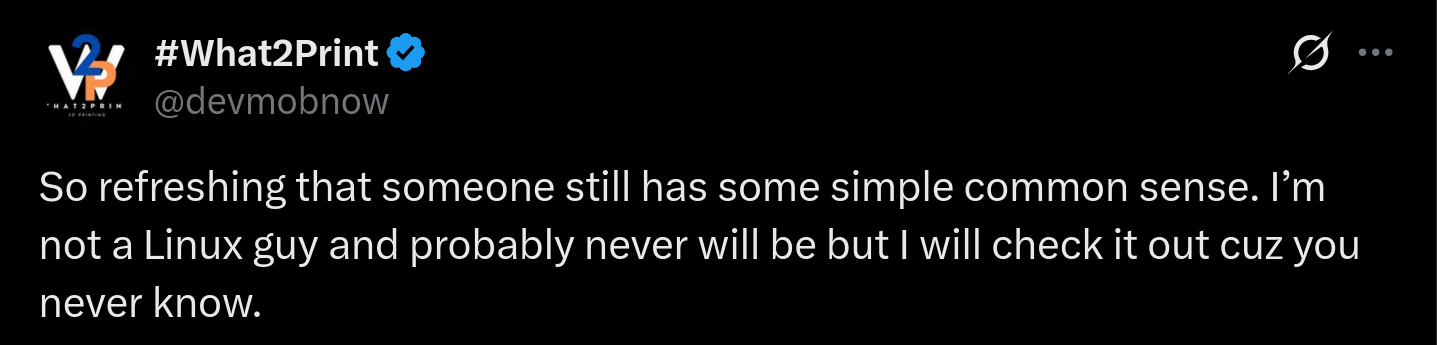
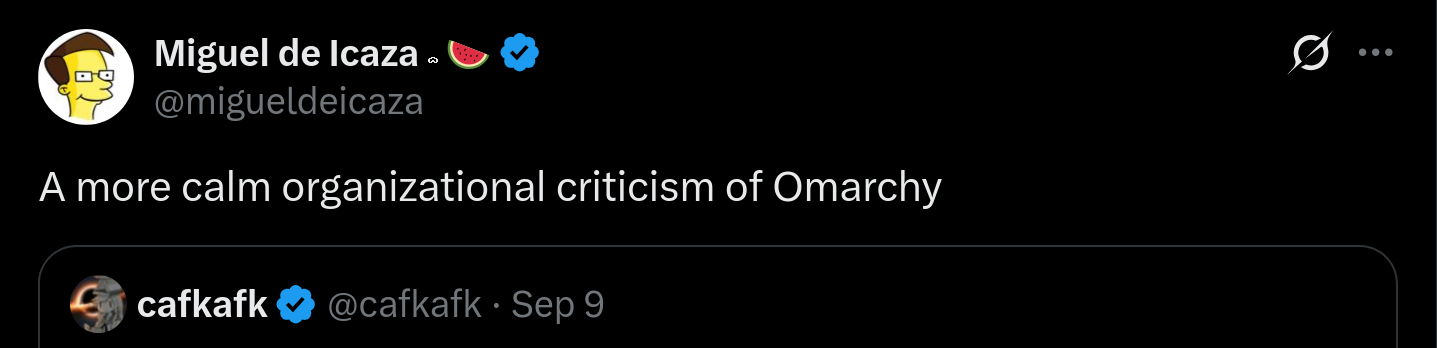
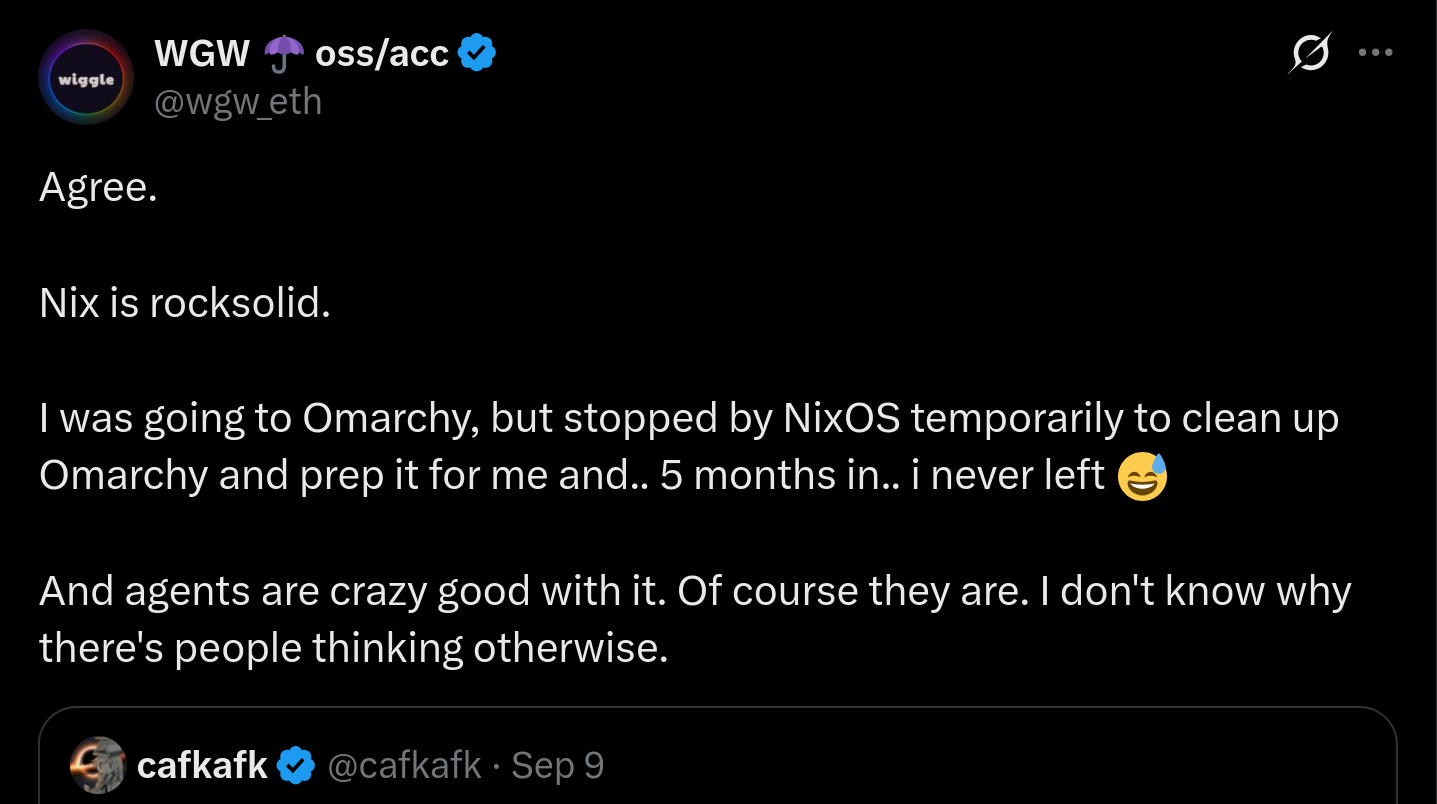
I of course also have numerous DMs in a similar vein.
I’ve also had (in Danish) productive discussions with DHH himself about NixOS, where I’ve tried to give him some context on how our actual community works, and how it’s less black and white than it might seem on the outside. I also think he understood how twitter might amplify the statements of specific voices that say things that are very easy to dunk on from the outside, but how that’s just as easy to cherrypick other voices on the “opposite” side of culture war issues. And how the solution isn’t just to silence them, at least not as a knee jerk reaction.
We do not agree on most things, but I don’t think that’s a good reason for me to not be willing to engage with him, specially since I hope that giving him a more accurate picture of how our community works, which he has been somewhat receptive towards, will lead to his own communication being less antagonistic of NixOS. He seems to have come to view us more as a “different philosophy” that just a overzealous and angry.
And I think keeping those lines open is crucial. Even when we can’t control how others use our code, maintaining a working relationship gives us a channel to address technical or cultural risks to our project. I don’t expect others to have the willingness to do that, but I do expect that of myself as long as good faith is maintained.
Wasn’t intended as an attack, more just an observation on the state of reality, and the irony of it showing up so clearly right here. Sorry it seemed like one.