Hello! I wanted to share a project I’ve been working on for the past several months and get some feedback from the community. This is Crystal Forge and I want to be upfront: it’s super early stage. At best, it’s a proof of concept. These past few months have been largely me learning Rust and the nuances of the Nix CLI.
What I’m Building Toward
The long-term vision is to make NixOS easier to use in compliance-heavy environments (government, banking, defense, etc.) than traditional solutions like RHEL. I’ve put together some slides that give an overview of my plans: https://crystalforge.us
Why This Matters
The TL;DR: Nix gives us deterministic, cryptographically-verifiable knowledge of exactly what’s on every deployed system. This means we can:
- More easily verify compliance
- Deploy compliant configurations with confidence
- Know precisely when ALL systems are patched
- Track the complete provenance of every system state
Crystal Forge just puts a nice bow on things and stores it all in a database to make it easier when it comes to do your audits.
What Actually Works Today
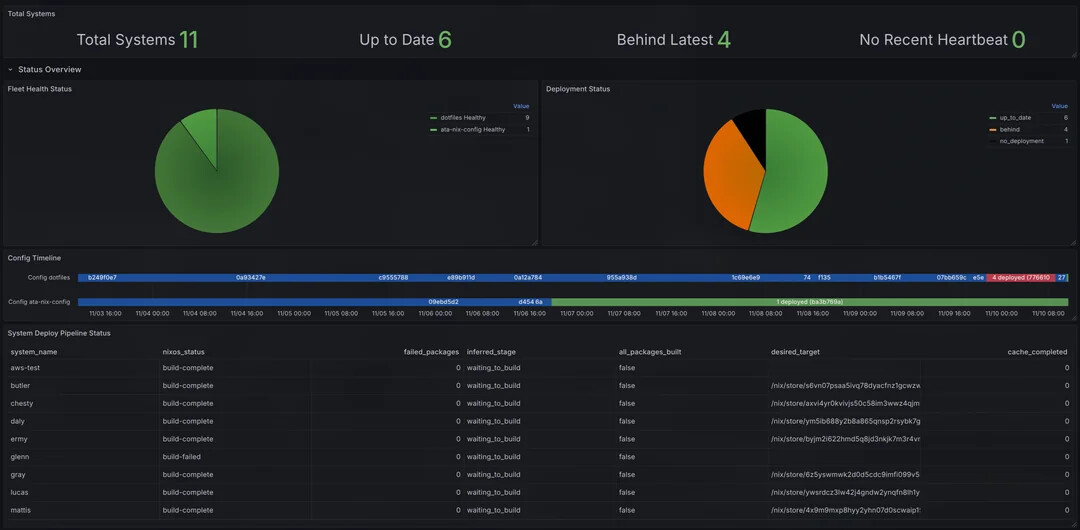
Right now Crystal Forge is really just for homelabbers and tinkerers, but here’s what’s functional:
A Build and deploy framework - Basic monitoring and tracking of systems across multiple Flakes/Git repos
Deployment policies - Simple policies like “always latest” or “manual,” with the groundwork for more complex, extensible policies. Currently they just verify Crystal Forge is enabled, but this can be extended to verify STIGs or other compliance requirements
CVE scanning - Using Vulnix to scan all systems and store results (will integrate this into deployment policies next)
Basic Grafana dashboards - Rudimentary but functional for monitoring. Eventually I want a proper web interface, but Grafana works for now
What’s Coming
I have proof-of-concept STIG generation functions (example-here) that will require attestation for why certain controls are disabled. The goal is to keep all accreditation metadata in a single, verifiable place and output it to formats like OSCAL.
Technical Notes
This is my first Rust project, so there’s definitely some learning-curve and AI slop scattered throughout the code The builder services use systemd-run for resource limiting. With proper configuration, you should be able to reliably build even the heaviest systems (Electron, Firefox, etc.). I have a Ryzen 9 7950X3D and am able to pretty reliably build Electron and Firefox without problem. I’ve implemented an extensive integration test suite, though there are still gotchas I’m working through (like actually building inside NixOS test VMs. If anyone has ideas, I’m all ears!)
Links
Crystal Forge repo: https://gitlab.com/crystal-forge/crystal-forge
My dotfiles (to see it in action): https://gitlab.com/usmcamp0811/dotfiles
Next Steps
My immediate priority is a big refactor to clean up the architecture and consolidate some of the experimental implementations. After that, I’ll work on CVE visualization and integrating CVE data into deployment policies. I’m not a project manager, a security person, or a professional Rust developer – I’m figuring this all out as I go. I’ve had some input from friends, but it’s mostly been me hacking away at this. There’s a ton I know I need to do, and I’m completely open to thoughts, feedback, and collaboration. If this sounds interesting to you, I’d love to hear your ideas!